


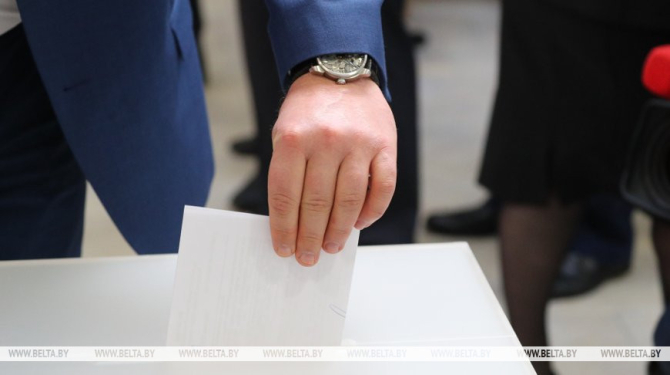
Igor Karpenko, Chairman of the Central Election Commission (CEC) of Belarus, spoke about what changes can be introduced to electoral legislation in the future during a visit to the College of Business and Law in Brest on 13 October, BelTA has learned.
According to Igor Karpenko, after each election campaign the CEC, together with the regions, analyzes the application of electoral legislation and the need for transformation. “Any system, however perfect it may be, must develop. It does not stand still," the chairman of the Central Election Commission stressed. He announced that certain innovations are envisaged for the future. “The changes we intend to consider are not of a conceptual nature. These are not the kind of changes that would come as a surprise to the main players in the political field during an election campaign: political parties, potential candidates who will take part in the Single Voting Day, and so on,” Igor Karpenko said.
One proposal concerns changes to legislation on the rational use of budget funds. "For example, a stationary voting booth costs more than a portable one or a screen that can be used. This is not our innovation — we observe it everywhere, including in the electoral systems of European countries," the CEC Chairman noted.
The concept of “electoral volunteering” may also be enshrined in electoral legislation. Such experience exists in CIS countries. “We were recently in Russia for the parliamentary elections and saw that this institution is developing quite actively. There are legal norms that ensure the activity of volunteers. They must understand what rights and duties they have and, accordingly, how they work in interaction with election organizers directly,” Igor Karpenko explained.
The CEC chairman noted that the institution of electoral volunteering is developing in Belarus. He cited as one of its elements the training laboratory for electoral law and legal education established at the College of Business and Law in Brest. Among other things, classes are held there for young people on the principle of “peer-to-peer learning”. “This underlines that our young people strive to know and understand what the electoral system is and to take a conscious part in elections,” he said.


